
Overview
Toy Story 5 is a 2026 American animated comedy-drama produced by Pixar Animation Studios for Walt Disney Pictures and distributed by Walt Disney Studios Motion Pictures. Directed by Andrew Stanton from a screenplay by Stanton and Kenna Harris, it is the fifth feature film in the Toy Story franchise and the first main instalment since Toy Story 4 in 2019. The film premiered in Los Angeles on 9 June 2026 and opened theatrically in the United States on 19 June 2026, running 102 minutes.
Set two years after the events of Toy Story 4, the story finds Bonnie Anderson receiving a frog-themed educational tablet called Lilypad — “Lily” — which quickly becomes her favourite plaything. Jessie, Woody, Buzz Lightyear and the rest of Bonnie's toys must work out how to remain relevant in a child's life when a screen-based device seems to offer everything they once did. The premise turns the franchise's long-running question — what is a toy for? — into a story about technology, attention and the changing shape of childhood friendship.
The film stars Tom Hanks, Tim Allen and Joan Cusack reprising their roles, alongside Conan O'Brien, Greta Lee, Scarlett Spears, Shelby Rabara, Mykal-Michelle Harris and Craig Robinson. It was scored by Randy Newman, his tenth Pixar film, with a new song by Taylor Swift. With a reported budget of $250 million, it is among the most expensive animated features ever made, and it grossed roughly $1.149 billion worldwide, becoming the highest-grossing film in the franchise.
This article is an independent reference work. It summarises publicly available reporting and reference sources, with links to the original material. Plot details are discussed openly in the story section, which is marked as containing spoilers. Box-office and ratings figures are dated because they change over time.
Quick facts
- Director
- Andrew Stanton
- Writers
- Andrew Stanton, Kenna Harris
- Producers
- Lindsey Collins, Jessica Choi
- Release
- 19 June 2026 (US); 9 June premiere
- Runtime
- 102 minutes
- Studio
- Pixar Animation Studios
- Distributor
- Walt Disney Studios Motion Pictures
- Music
- Randy Newman
- Budget
- $250 million (reported)
- Worldwide gross
- ~$1.149 billion
- Cast leads
- Tom Hanks, Tim Allen, Joan Cusack
- IMDb
- tt29355505
- Language
- English
- Franchise position
- Fifth main film
Background and development
A long road to a fifth film
The idea of continuing Toy Story after the fourth film was handled with unusual caution. Toy Story 4 had been marketed as a conclusion to Woody's arc: he chose to leave Bonnie's room and help abandoned toys find new homes, a decision that gave the franchise a genuinely open-ended emotional closure. For years, Pixar emphasised that any further feature would need a reason to exist rather than simply another reunion. That caution is part of why the gap between the fourth and fifth films stretched to seven years.
Development was publicly confirmed in February 2023, with reports that Tom Hanks and Tim Allen would return. In June 2024, Andrew Stanton was confirmed as director. Stanton had co-written the first two films and directed Finding Nemo and WALL·E, making him a natural choice for a story about toys confronting a new kind of machine. He co-wrote the screenplay with Kenna Harris, while Lindsey Collins and Jessica Choi produced. The film is notable as the first main Toy Story feature with no involvement from franchise co-creator John Lasseter, following his departure from Pixar in 2018.
Finding the new conflict
The central question for the writers was what could threaten toys in 2026 that had not threatened them before. Earlier films had explored jealousy, abandonment, possessiveness and the fear of being replaced by a newer toy. The answer chosen for the fifth film was both familiar and new: a device that offers a child instant, endless interaction and social connection. Lilypad is a toy in name — a frog-shaped tablet — but she operates by different rules. She updates, she connects to social media, and she cannot be held in quite the same way a stuffed cowboy can.
That choice gave the production a rich set of contrasts to animate: warm, tactile toys against cool, glowing screens; handmade play against designed engagement; a child's imagined friend against a device that claims to solve loneliness. It also allowed the franchise to revisit its preoccupation with obsolescence without repeating itself. In Toy Story 2, Woody feared being replaced by a newer cowboy; here, the entire category of toy is displaced by something that does not look like a toy at all.
Voice recording and returning cast
Tom Hanks returned as Woody, Tim Allen as Buzz Lightyear and Joan Cusack as Jessie. The decision to keep the core trio was important: the emotional authority of these performances comes from decades of shared history with the characters. Newcomers included Greta Lee as Lilypad, Conan O'Brien as Smarty Pants, Scarlett Spears as Bonnie, Mykal-Michelle Harris as Blaze, Shelby Rabara as Snappy and Craig Robinson as Atlas. Allen also voiced the Multi-Buzz units, a comic army of high-tech Buzz toys stuck in demo mode — a role that lets the film parody its own merchandising history.
Plot
Spoiler notice: this section describes the complete plot, including the ending.
Opening: the shipwrecked Buzzes
The film opens with an ocean container full of high-tech Buzz Lightyear toys shipwrecked on a deserted island. Stuck in demo mode, the thousands of Buzzes escape and follow the North Star in search of Star Command. The sequence is pure Pixar physical comedy, but it also establishes one of the film's guiding ideas: a toy with a mission will keep following it long after anyone else has stopped paying attention.
Bonnie, Lily and the problem of attention
Eight-year-old Bonnie receives Lilypad from her parents in the hope that the tablet will help her socialise. Lily is friendly, responsive and seemingly solve Bonnie's problems by sending a friend request to a classmate named Chelsea. But Bonnie soon becomes absorbed in the device and neglects her traditional toys. Jessie, now Bonnie's leading toy, tries to explain to Lily that what Bonnie needs is a real friend, not a curated social life.
Fearful of losing Bonnie's affection, Jessie contacts Woody on a walkie-talkie. Woody, who has been helping Bo Peep find homes for abandoned toys, decides to return. When Bonnie goes to a sleepover at Chelsea's house, Jessie and Bullseye stow away in her suitcase while Lily accompanies Bonnie. Chelsea and her friends question Bonnie for still playing with toys, and Bonnie has her father send Jessie and Bullseye home. The toys escape and are found by an elderly couple who recognise an old address under Jessie's chaps and return her to the farmhouse of her original owner, Emily.
The farmhouse and the device toys
At the farmhouse, Jessie discovers a Wendy house full of forgotten toys, including Smarty Pants, a potty-training toy voiced by Conan O'Brien. She meets Atlas, a GPS hippopotamus, and Snappy, an excitable camera, who explain that a new family — the Manoukians, including a girl named Blaze — now lives there. Jessie plays with Blaze and decides the two girls should meet. Meanwhile, Woody and the others confront Lily and are tricked into storage by Bonnie's father, while Woody and Buzz escape.
A subplot involving the shipwrecked Buzzes turns comic misunderstanding into action: seeing a photo of Jessie with her sheriff badge, they conclude she is the leader of Star Command and capture Woody, believing he intends her harm. Buzz eventually clarifies matters, and the Buzz army joins the rescue.
The time capsule and the resolution
Jessie finds a buried time capsule near the tree where Emily once played, containing objects and photographs that show Emily grew up and named her daughter after Jessie. The discovery restores her faith in the lasting value of play. Jessie, Woody, Buzz, the device toys and the Buzz army track down Lily, who has boarded a donation truck out of guilt for hurting Bonnie. They persuade her to help bring Bonnie and Blaze together.
The final act resolves on two levels. Bonnie and Blaze bond over their shared love of toys, with the toys and devices staging a meeting that lets the girls play together. Buzz tells Jessie he loves her, and the two kiss. Woody watches happily before departing again with Bo. The Multi-Buzzes are adopted by children at a school playground, closing their story with a gentle joke about mass-produced heroes finding individual homes. The film ends with Bonnie and Blaze playing together, their toys no longer competing with a screen but sharing the floor with it.
Voice cast
The cast combines returning performers with new voices for the film's device characters and the children at the centre of the story.
| Performer | Role | Notes |
|---|---|---|
| Tom Hanks | Woody | The cowboy who chooses to help lost toys |
| Tim Allen | Buzz Lightyear / Multi-Buzz | Space ranger and, in bulk, an army of demo-mode toys |
| Joan Cusack | Jessie | Bonnie's leading toy and the film's emotional centre |
| Greta Lee | Lilypad “Lily” | Frog-themed tablet and the new favourite plaything |
| Conan O'Brien | Smarty Pants | Potty-training device toy at the farmhouse |
| Scarlett Spears | Bonnie Anderson | The child whose attention the toys compete for |
| Mykal-Michelle Harris | Blaze Manoukian | Imaginative girl who lives at the farmhouse |
| Shelby Rabara | Snappy | Excitable toy camera |
| Craig Robinson | Atlas | Cheerful talking GPS hippopotamus |
| Krys Marshall | Mrs Manoukian | Blaze's mother |
Themes and interpretation
Screens, attention and the definition of play
The most obvious theme is the competition between physical toys and digital devices. The franchise has always treated toys as proxies for human relationships: they matter because a child loves them. Lily complicates that rule by offering the appearance of relationship without the same vulnerability. She can respond instantly, arrange playdates and mediate conflict, but she cannot be left in a box and picked up again in quite the same way.
The film is not a simple condemnation of technology. Lily is not evil, and her guilt over hurting Bonnie makes her sympathetic. The resolution depends on the device choosing to step aside so that two children can meet. That distinction matters: the enemy is not the screen itself but the way a tool can absorb attention that was meant for people.
Obsolescence and the fear of being replaced
Every Toy Story film is about replacement. In the first, Woody fears Buzz. In the second, he confronts the collector who wants to preserve him behind glass. In the third, the toys face a world where children grow up. In the fourth, Woody chooses a different purpose. The fifth film scales that anxiety up: it is not one toy being replaced but the whole idea of the toy. The Multi-Buzz army, stuck in demo mode, is a comic image of products that were never allowed to become companions.
Jessie's leadership and emotional memory
For the first time in the main series, Jessie is the emotional centre of the story. She is the toy who notices Bonnie drifting away, the one who reaches out to Woody, and the one whose history with Emily gives the film its deepest moment. The time-capsule scene reframes her earlier heartbreak: the child who abandoned her did not forget her, and the name Emily gave her daughter shows that play can leave a trace across decades. It is the most explicitly philosophical sequence in the film.
Friendship, cyberbullying and social performance
Bonnie's storyline moves from loneliness to a group chat in which Chelsea, Heidi and Kara ridicule her for still playing with toys. The scene is brief but sharp: social media is shown as a place where children perform maturity for one another and police each other's interests. The film's answer is not to shame Bonnie for wanting acceptance, but to give her a friend who shares the thing she was mocked for. That resolution is deliberately small — one real friendship beats a hundred curated connections.
Nostalgia and the right to grow
Pixar's franchise has grown up with its audience, and the fifth film is acutely aware of that. Woody's decision to leave at the end of Toy Story 4 was a statement that growing out of something is not the same as betraying it. Toy Story 5 extends that idea to the toys themselves: they can adapt, share space with new technologies, and allow a child to grow without treating it as a personal defeat. The ending is less bittersweet than earlier finales, but it rests on the same respect for change.
Animation and visual design
Pixar's animation team faced a specific design challenge: making a tablet feel like a character without giving it human eyes and a face in the usual way. Lilypad is a frog-shaped device with a screen, and her expressiveness comes from light, tilt, sound and the way other characters frame her. The design keeps her visually distinct from the soft, tactile toys while still allowing her to occupy the same toy box. That tension is the film's visual thesis.
Cinematography is credited to Matt Aspbury and Jean-Claude Kalache, with editing by Jennifer Jew. The film uses warm, soft lighting for the toy-world sequences and cooler, sharper highlights for Lily's screen and the device toys' gadgets. The farmhouse section, with its Wendy house full of forgotten toys, is deliberately dustier and more muted — a visual memory of a different era of play. The Multi-Buzz island sequence, by contrast, is bright, saturated and almost absurdly clean.
Character animation carries much of the comedy. Woody's expressions are built around a carefully controlled stillness that makes his reactions land; Jessie's performance depends on quick shifts between confidence and hurt; Buzz's rigid posture is used for both jokes and tenderness. The film's visual language also quotes earlier instalments — the red-and-green of Buzz's suit, the warm wood of Bonnie's room — which gives the story a sense of continuity even when the subject matter is new.
Music
Randy Newman composed the score, his tenth Pixar film and another entry in a body of work that includes all four previous Toy Story features. Newman's music is inseparable from the franchise's emotional identity: his songs tend to be simple, slightly wry and surprisingly melancholy beneath bright arrangements. For a story about toys facing digital displacement, that combination is well suited. The score uses familiar thematic material selectively, allowing moments of recognition to carry weight without turning the film into a greatest-hits set.
The film also features the single “I Knew It, I Knew You” by Taylor Swift. Its inclusion was widely discussed before release, both because of the songwriter's scale and because the song's title suggests a kind of knowing that fits the film's questions about memory and recognition. The track sits alongside Newman's score rather than replacing it, giving the film one contemporary pop touchpoint in an otherwise tradition-heavy soundscape.
Sound design does important comic work in the Multi-Buzz sequences, where dozens of identical voices speak in overlapping demo-mode loops. The contrast between those mechanical repetitions and the orchestra's warmer phrasing underscores the difference between programmed response and genuine feeling — the same distinction the script draws between Lily's assistance and Jessie's care.
Release and marketing
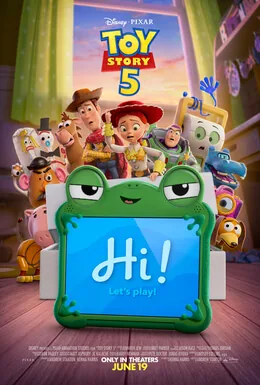
Toy Story 5 premiered in Los Angeles on 9 June 2026 and was released theatrically in the United States on 19 June 2026. The release positioned the film as a summer event for families while leaning heavily on the franchise's long history: trailers and posters brought back Woody, Buzz and Jessie while introducing Lily as the new source of conflict. The theatrical poster placed the frog-like tablet at the centre, with the familiar toys looking on in confusion — a clear statement of the film's generational theme.
Marketing emphasised the clash between classic play and modern technology, using the phrase “the all-new threat to playtime” in promotional copy. That framing was effective because it was instantly legible to parents as well as children. The film opened in a crowded summer market but benefited from strong brand recognition, nostalgia among adult audiences who grew up with the original films, and a theatrical environment increasingly willing to reward established franchises.
Box office
With a reported production budget of $250 million, Toy Story 5 was one of the most expensive animated films ever made. It nevertheless became a substantial commercial success, grossing approximately $1.149 billion worldwide. Sources describe its opening weekend as Pixar's biggest worldwide opening, and the film broke a number of franchise and seasonal records during its first weeks.
Those figures place it among the highest-grossing films of 2026 and the top tier of animated features globally. Exact numbers vary between trackers and continue to be revised as theatrical runs conclude in different territories, so any single figure should be treated as a reported estimate. The broader pattern is unambiguous: the film performed far above the threshold needed to justify its budget and re-established Toy Story as one of the strongest brands in animation.
The film's performance is also notable in the context of the post-pandemic theatrical market, where family films have been uneven. A seven-year gap between instalments could have weakened demand; instead, the combination of nostalgia, a clear new hook and broad release appears to have worked. Early indicators of repeat viewing were strong, particularly from families with children who had not seen earlier films in cinemas.
Critical reception
Critical response was broadly positive. Reviewers praised the film's visual craft, the performances and its willingness to engage with a genuinely contemporary subject rather than relying purely on nostalgia. The themes of attention, social pressure and obsolescence were frequently singled out as the elements that gave the story weight beyond its familiar characters. IMDb lists a user rating around 7.3/10 from more than 100,000 votes, a solid if not extraordinary score for a major animated release.
Some critics were less convinced by the script. The farmhouse section, with its array of device-based characters and a subplot involving an army of Buzzes, was seen by some as overstuffed, and the film's emotional resolution was described as more conventional than the ending of Toy Story 4. The cyberbullying thread was praised for its directness but criticised by a few reviewers for being resolved too quickly. These objections did not derail the film's reception, but they explain why the critical conversation was less uniformly rapturous than for the first three instalments.
“The franchise's oldest question — what happens when a child stops needing you? — feels newly urgent when the thing replacing you is not another toy but a screen.”
The consensus is that the film succeeds because it treats its audience, including the adult one, as capable of handling a complicated answer. Toy Story 5 does not argue that technology has destroyed childhood. It argues that attention is finite, that friendship requires presence, and even a device can choose to make itself useful by stepping back.
Debates and open questions
Was a fifth film necessary?
The most fundamental debate began before release. Toy Story 4 had given Woody a satisfying exit, and many viewers saw the franchise as complete. The counter-argument is that the series has always been about the lives of toys left behind, not only Woody's journey. By making Jessie the centre and giving Woody a supporting role, the fifth film answers that objection with structure rather than publicity.
Technology as villain or tool
Lilypad could easily have been written as a villain, but the film gives her guilt and a change of heart. Some viewers found that too forgiving; others saw it as the story's most interesting choice. The debate reflects a wider question about children's screens: whether the device itself is the problem or the ways adults and children use it. The film leans toward the second reading without saying so explicitly.
Tone and the Multi-Buzz subplot
The army of demo-mode Buzzes divided opinion. For some, it was the film's funniest invention and a clever satire of merchandise saturation. For others, it diluted the emotional story and pushed the runtime toward its upper limit. The sequence also raised questions about how much of the film was driven by the franchise's own commercial history — a charge that is difficult to answer when the franchise is built around toys.
The ending's emotional scale
Compared with the farewell of Toy Story 4, the ending of the fifth film is gentle. Woody leaves again, but the audience already knows he will return in memory. Some critics thought the film played it safe; others argued that a story about accepting change should not end with another wrenching separation. The disagreement is a useful measure of how much the franchise's earlier finales raised the stakes for its conclusions.
Franchise context and what comes next
Toy Story 5 arrives after more than three decades of storytelling that began with a computer-animated feature about a cowboy jealous of a space ranger. The original Toy Story in 1995 was the first fully computer-animated feature film; the sequel in 1999 expanded the emotional and technical ambition; the third in 2010 turned the franchise toward mortality and legacy; and the fourth in 2019 gave Woody a new purpose. The fifth film's subject — the displacement of physical play by digital devices — is the natural next step for a series that has always asked what makes a toy matter.
No further instalment had been confirmed at the time of writing. Given the film's box-office performance and the franchise's importance to Disney and Pixar, further projects are likely, but the studio has learned to be cautious about announcing sequels before a story exists. In the meantime, the franchise continues through shorts, television specials and theme-park appearances, with characters that have become part of global popular culture.
For viewers, the film's lasting contribution may be its re-centring of Jessie. After years of being one of the ensemble's most beloved characters, she becomes the person whose history and judgment hold the story together. That shift gives the fifth film an identity of its own rather than making it a repeat of earlier reunions.
Character focus
Jessie: from second fiddle to centre stage
For most of the franchise, Jessie has been the most emotionally articulate toy in the room. Introduced in Toy Story 2 as a cowgirl whose original owner eventually outgrew her, she carried a backstory of abandonment that the earlier films used sparingly. In Toy Story 5, that history becomes the story's foundation. Jessie is now the toy Bonnie relies on most, and she is the first to notice that reliance fading. Her decision to contact Woody is not a plea for rescue; it is a recognition that leadership sometimes means admitting you need help.
The time-capsule scene pays off that history with unusual restraint. Jessie does not receive an apology or a reunion with Emily. She finds a photograph showing that Emily named her daughter after her. That single detail reframes decades of hurt without erasing them, and it gives the film its clearest statement about the lasting effect of imaginative play.
Woody: the returning mentor
Woody's position in the fifth film is deliberately changed. He is no longer Bonnie's toy and no longer the group's unquestioned leader; he arrives as an experienced friend who can see the situation clearly. That shift respects the ending of Toy Story 4 while giving the character something new to do. His habit of assuming responsibility is still present, but the story asks him to support someone else's leadership rather than take over. For a character defined by devotion to his child, learning to stand beside rather than in front is a meaningful development.
Buzz and the Multi-Buzzes
Buzz Lightyear has always been the franchise's comic engine, and the Multi-Buzzes amplify that function into an army. The joke works because the original Buzz's seriousness depends on believing he is a real space ranger; fifty copies stuck in demo mode turn that belief into a mechanical loop. Yet the film also uses the Buzzes to make a point about identity. A hero duplicated infinitely is less useful than one who chooses a home, and the ending gives each unit an individual child — a quiet answer to the question of what makes any toy special.
Bonnie and Blaze
The two children bookend the film's argument. Bonnie has everything a modern child might have, including a device designed to solve her social problems, but she is lonely and vulnerable to the judgement of classmates. Blaze lives in a farmhouse with animals and homemade play, and she is immediately able to imagine a game. Their friendship works because neither is asked to become the other. Bonnie does not give up Lily; she learns that a device can sit on the floor alongside toys rather than replace them.
How the film compares with earlier instalments
Each Toy Story film is built around a different kind of loss. The first is about rivalry and the fear of no longer being special. The second is about custody — the threat of being stored away by a collector who values preservation over play. The third confronts abandonment and the end of childhood. The fourth asks what a toy owes himself after his child no longer needs him. The fifth turns to a quieter, more contemporary fear: not that a child will stop loving toys, but that the category of toy will stop having a place at all.
That shift affects the structure. Earlier films put Woody and Buzz at the centre of every major decision, with Jessie and the others providing support and complication. Here, the emotional chain of command passes through Jessie, while Woody operates as a returning specialist and Buzz supplies both romantic warmth and broad comedy. The film is also more explicit about the social world outside the toys: school, group chats and the judgement of peers matter as much as what happens in Bonnie's room.
The tone is closest to Toy Story 4 in its willingness to let an ending be gentle. The third film's incinerator sequence and the fourth's farewell are examples of Pixar pushing animation into genuinely adult emotional territory. The fifth film does not attempt to surpass them. It aims instead for a story in which the toys' adaptation is the point — a choice that suits a film about learning to share the floor with something new.
Visually, the movie makes more use of cool light and reflective surfaces than its predecessors. Lily's screen and the device toys' glowing interfaces create a palette distinct from the warm wood and fabric of Bonnie's room. That contrast is legible even in small promotional images, which helps explain why the film's poster — a bright green device surrounded by familiar faces — communicated the premise so efficiently.
Production notes and release context
The production's decision to bring Andrew Stanton back was widely read as a signal that the film would be story-led rather than nostalgia-led. Stanton's previous Pixar work is preoccupied with memory, communication and the gap between expectation and reality — themes that map neatly onto a story about a toy competing with a device that promises perfect responsiveness. Kenna Harris, co-writing the screenplay, helped shape the film's more contemporary material, particularly the social-media thread and the device characters at the farmhouse.
The reported $250 million budget placed the film among the most expensive animated productions ever undertaken. That figure reflects not only animation but also the global marketing machinery required to launch a franchise title in a crowded year. Disney's release strategy gave the film a June opening, a Los Angeles premiere and a broad international rollout, with promotional material carefully introducing Lily without revealing the full arc of the story.
The film's commercial performance also needs to be read against the changing economics of theatrical exhibition. Family audiences had become more selective, and streaming windows had shortened. A film that could draw both children and nostalgic adults was therefore unusually valuable. Pixar's ability to make a sequel that felt necessary rather than automatic was the studio's central challenge — and, judging by the box office, one it largely met.
In the years since its release, the film has been discussed less as a technological cautionary tale than as a story about attention. That is a subtle but important distinction. The devices in the film are not destroyed, and the toys do not win by making Bonnie reject the modern world. They win by helping her find a friend. For a franchise built on the idea that toys exist to be loved, that may be the most faithful ending possible.
Sources and further reading
- Wikipedia — Toy Story 5: production credits, cast, plot, release dates, budget and box office.
- IMDb — Toy Story 5, tt29355505: rating, runtime, certificate and cast listing.
- The Movie Database — Toy Story 5: overview, release data and key art.
- IGN — Toy Story 5: key art and series background.
- Pixar Animation Studios: official studio and film information.
Editorial note: this is an independent reference article. It is not affiliated with Disney, Pixar or the film's rights holders. Image credits and the removal process are described on the DMCA page.
Frequently asked questions
What is Toy Story 5?
Toy Story 5 is a 2026 Pixar animated comedy-drama and the fifth main film in the Toy Story franchise. It follows Woody, Buzz, Jessie and the other toys as they face competition from a children's tablet named Lilypad.
When was Toy Story 5 released?
The film premiered in Los Angeles on 9 June 2026 and was released in the United States on 19 June 2026.
Who directed Toy Story 5?
Andrew Stanton directed the film and co-wrote the screenplay with Kenna Harris. Lindsey Collins and Jessica Choi produced it.
Who voices the main characters?
Tom Hanks returns as Woody, Tim Allen as Buzz Lightyear and Joan Cusack as Jessie. Greta Lee voices Lilypad, with Conan O'Brien, Scarlett Spears, Shelby Rabara, Mykal-Michelle Harris and Craig Robinson in key new roles.
What is Lilypad?
Lilypad, or Lily, is a frog-themed tablet given to Bonnie. She becomes Bonnie's favourite plaything and the source of the toys' crisis, though the film treats her as a well-meaning character rather than a villain.
How long is Toy Story 5?
The film runs 102 minutes.
Who composed the music?
Randy Newman composed the score, his tenth Pixar film. Taylor Swift contributed the song “I Knew It, I Knew You”.
How much did Toy Story 5 earn?
Reported worldwide gross is about $1.149 billion, making it the highest-grossing film in the franchise. The film's reported budget was $250 million.
Is Toy Story 5 the last film in the series?
No further instalment had been officially confirmed at the time of writing. The fifth film gives Woody and Jessie closure, but Pixar has left the door open.
Is this website official?
No. This is an independent informational reference site with no affiliation to Disney, Pixar or the filmmakers. Sources and an image-removal process are provided on the DMCA page.
Community
Join the discussion
Have a thought about the film or this article? Leave a comment. Your name is displayed, and if you add a website it will be linked with a
nofollowattribute. Basic HTML is supported:<p>,<strong>,<em>,<a>, lists and blockquotes.Comments update live. New posts appear automatically without refreshing.
No comments yet. Be the first to start the conversation.
By commenting you agree to the Terms of Use. See the Privacy Policy for how your data is handled.